Yandere Simulator Rivals – Names, Roles & Story Guide
The Yandere Simulator Rivals are at the center of the game’s main story and gameplay. Each rival has a different personality, relationship with Senpai, daily routine, and personal situation that makes their week feel different from the last one.
Some are already close to Senpai, while others develop feelings for him through their own circumstances. This creates a changing challenge because the same approach will not always work with every character. Relationships, schedules, reputation, and the people surrounding a rival can all affect how events unfold.
Understanding the rival system also makes the story easier to follow. These characters are more than simple obstacles placed in front of Ayano. They have their own backgrounds, friendships, interests, and reasons for becoming important during a particular week.
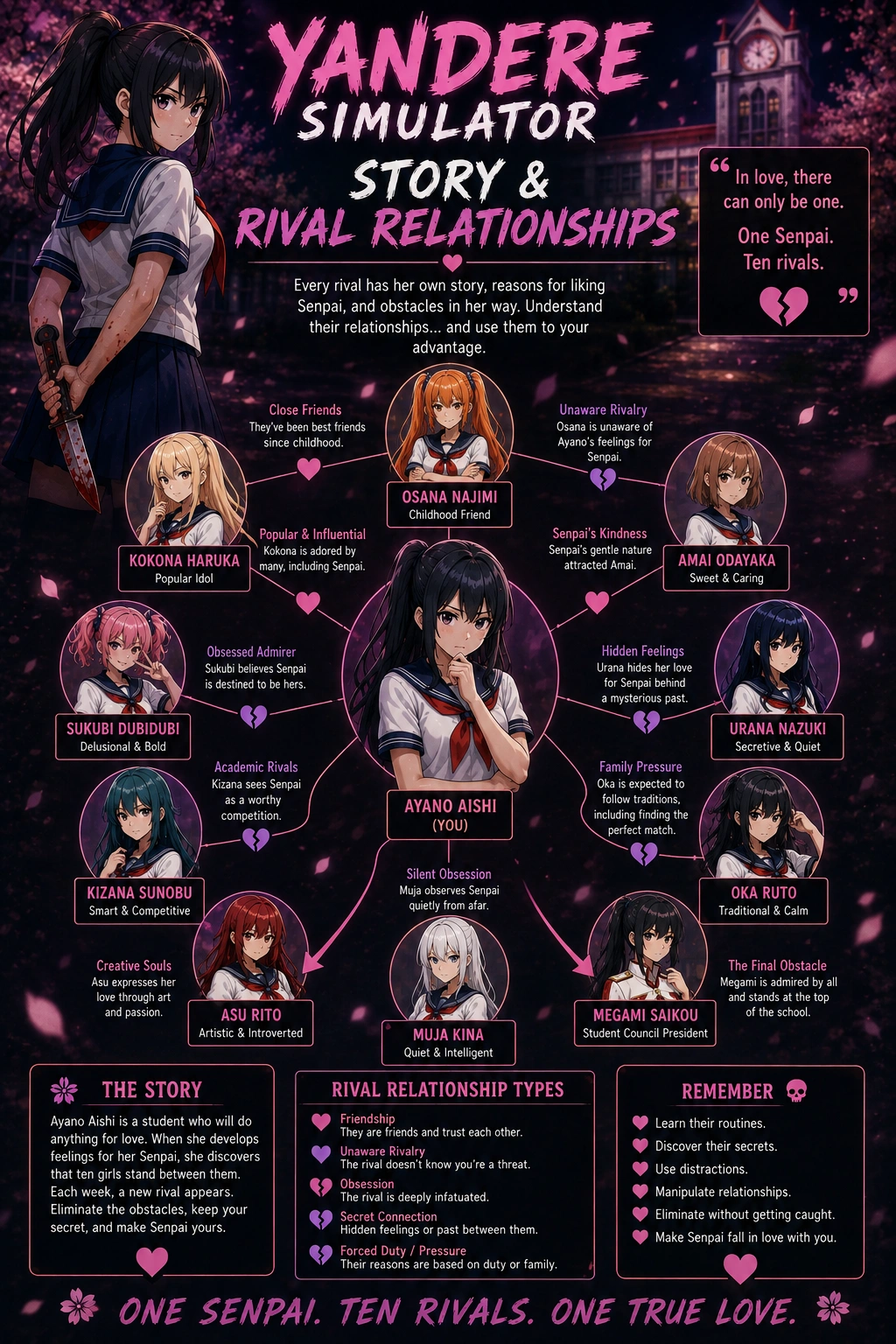
Who are the Rivals in Yandere Simulator?
The rivals are girls who have the potential to develop a romantic relationship with Senpai. Ayano’s main goal is to prevent that relationship from reaching a successful confession while dealing with each rival before the end of her assigned week.
Every rival brings a different situation to Akademi. One character may already know Senpai well, while another may become close to him because of a shared interest, a school activity, or a personal problem. This is what makes the system more interesting than simply repeating the same mission. A player needs to pay attention to the individual character and the environment around her.
The Role of a Rival
A rival acts as both a story character and a gameplay challenge. Her presence creates a new conflict for Ayano because she could potentially become Senpai’s romantic partner. However, the rival is also connected to other people at school. Friends, club members, teachers, and students can influence how easy or difficult it is to approach a particular situation.
Why Every Rival is Different
The characters are designed around different personalities and circumstances. Their routines, strengths, friendships, and emotional situations can change the way a week is approached. That variety is important because it encourages observation instead of blindly using one strategy every time. What works smoothly during one week may become risky or impractical during another.
A Note about Rival Information and Game Versions
Yandere Simulator is an actively developed game, so rival-related information can change as new builds and story content are introduced. Names, routines, gameplay mechanics, and the availability of certain features may not be identical across every version.
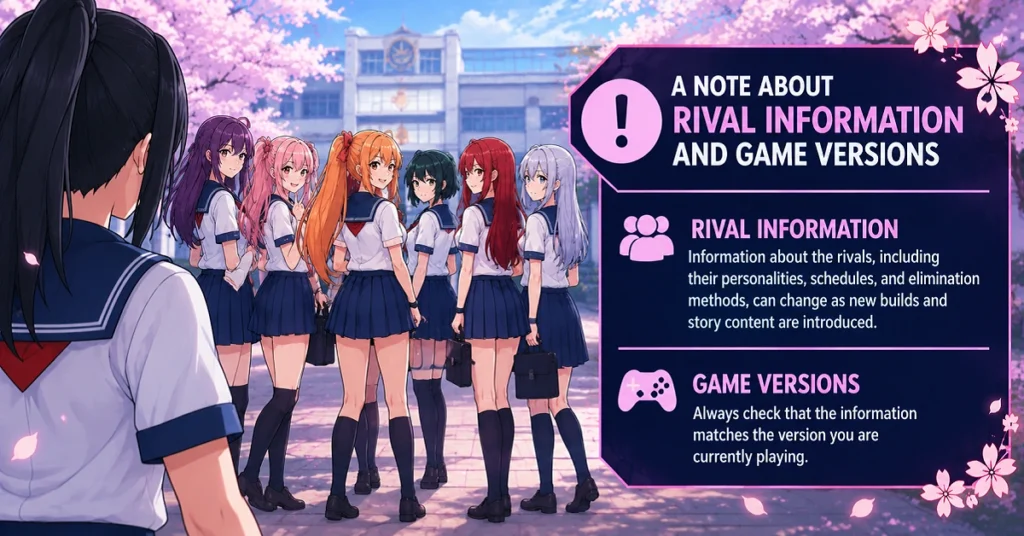
This guide focuses on the established rival structure and separates the main storyline from 1980s Mode, fan-created concepts, and modifications. If you are checking a specific rival or gameplay method, it is worth confirming that the information matches the version you are currently playing.
This is especially important for older guides and videos, which may describe mechanics that have since changed, so readers looking for the Yandere Simulator Mobile Download should also check the latest game and platform information.
Yandere Simulator Rivals Names
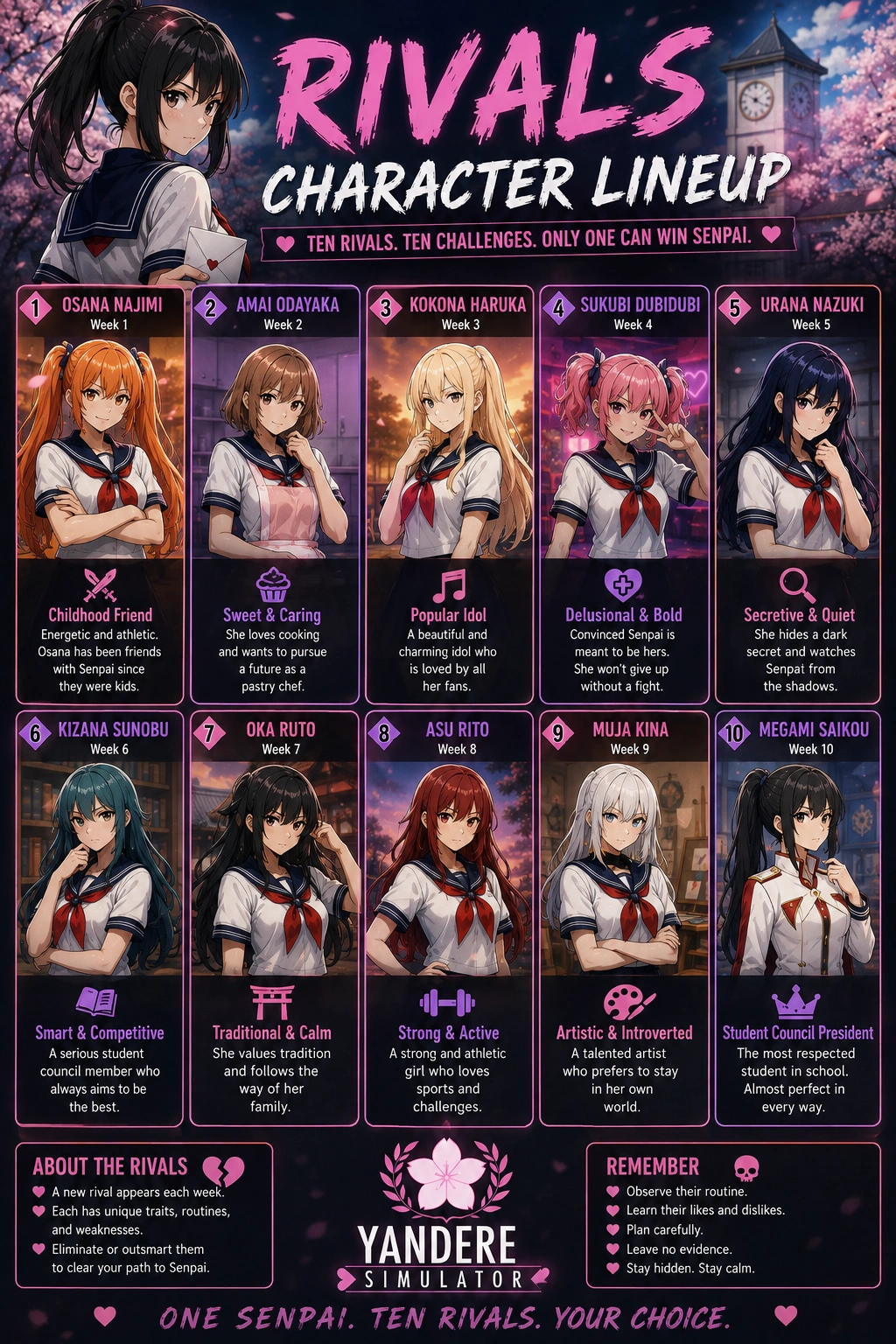
The main 202X storyline is built around ten major rivals: Osana Najimi, Amai Odayaka, Kizana Sunobu, Oka Ruto, Asu Rito, Muja Kina, Mida Rana, Osoro Shidesu, Hanako Yamada, and Megami Saikou.
Each character has a distinct role in the overall progression. The order also matters because the challenge is intended to develop as the story moves forward and new rivals introduce more complicated circumstances.
The list gives a clear picture of how varied the characters are. Childhood friends, club leaders, students with unusual interests, family connections, and powerful school figures can all create different types of problems for Ayano.
Yandere Simulator – All Rivals and Their Roles
The rivals in Yandere Simulator are introduced progressively, with each character bringing a different personality, relationship, and challenge to the story. Their roles range from Senpai’s childhood friend to school club members, staff characters, delinquents, and major figures connected to the wider storyline.
Osana Najimi – Senpai’s Childhood Friend
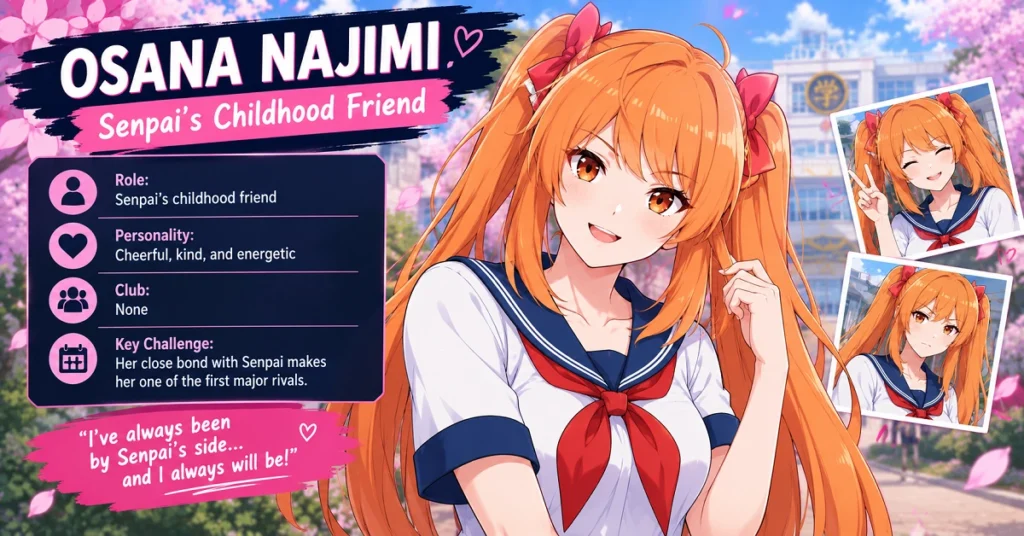
Osana Najimi is Senpai’s childhood friend and one of the first major rivals the player encounters. Her close relationship with Senpai makes her an important early challenge, while her personality adds a more personal form of competition for his attention.
Amai Odayaka – Sweet and Caring Rival
Amai Odayaka is known for her gentle and caring personality. Her connection to school activities and her friendly nature give her a different dynamic from Osana, making her rivalry more focused on personality and shared time with Senpai.
Kizana Sunobu – Confident Drama Club Rival
Kizana Sunobu is a confident and theatrical character associated with the Drama Club. Her strong personality and self-confidence make her stand out among the rivals and introduce a more expressive type of competition.
Oka Ruto – Mysterious Occult Rival
Oka Ruto has a quiet and mysterious personality and is closely associated with the Occult Club. Her unusual interests and reserved nature give her rivalry a darker and more mysterious atmosphere compared with the earlier rivals.
Asu Rito – Athletic Rival
Asu Rito is an athletic character associated with the Sports Club. Her energetic personality and involvement in school sports make her role distinct from rivals who are primarily connected to clubs, academics, or personal relationships.
Muja Kina – Nurse and Adult Rival
Muja Kina is connected to the school environment through her role as a substitute nurse. Her character introduces a different type of relationship dynamic because she is an adult working within the school rather than a regular student rival.
Mida Rana – Substitute Counselor
Mida Rana is another adult character associated with the school environment. Her role as a substitute counselor gives her a different position within the storyline and separates her from the student rivals who make up much of the earlier progression.
Osoro Shidesu – Delinquent Leader
Osoro Shidesu is known for her tough reputation and connection to the school’s delinquent group. Her presence raises the difficulty and introduces a more intimidating personality compared with the rivals encountered earlier in the story.
Hanako Yamada – Senpai’s Sister
Hanako Yamada has a direct family connection to Senpai as his younger sister. This makes her role particularly different from the other rivals because her relationship with Senpai is based on family rather than a typical romantic rivalry.
Megami Saikou – Major Final Challenge
Megami Saikou represents one of the most significant challenges in the wider Yandere Simulator storyline. As a highly capable and influential student, she provides a major escalation in difficulty and serves as an important part of the game’s later progression.
Which Rival is the Hardest to Eliminate? (Difficulty Ranking)
Not every rival poses the same level of challenge. Based on personality, social protection, and school position, here’s a general difficulty order from easiest to hardest:
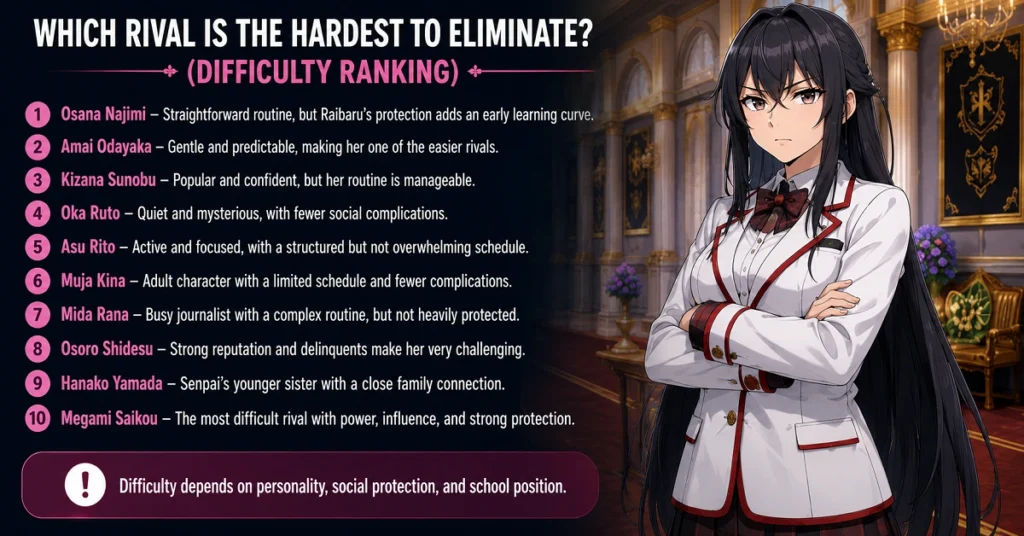
This ranking is based on general personality and social factors actual difficulty can shift depending on playstyle and game version.
Yandere Simulator First Rival
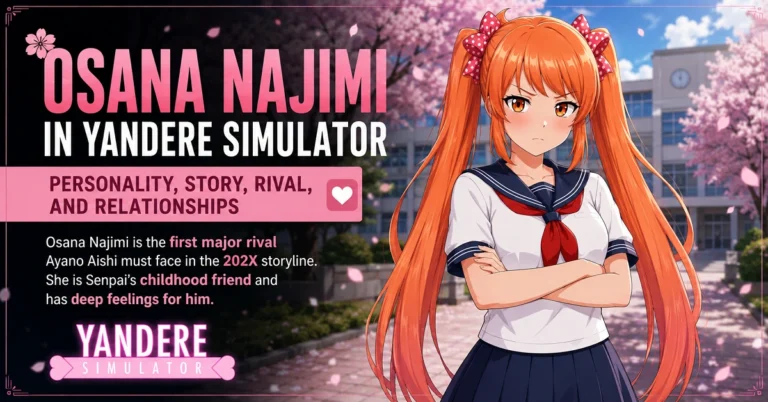
Osana Najimi is generally presented as the first major rival in the 202X storyline. Her role is important because her week introduces the basic idea of watching a rival, learning her routine, understanding her relationships, and deciding how to interfere with her plans.
Her connection with Senpai is easy to understand because they have known each other since childhood. At the same time, Raibaru’s close friendship with Osana shows that the people around a rival can become just as important as the rival herself.
I found this type of setup useful because it teaches an important lesson early: rushing toward the main character without checking the surroundings can quickly create unnecessary problems. Observation often gives more useful information than immediate action.
Osana Najimi
Osana is known for her strong personality and difficulty expressing her feelings honestly. She can appear impatient or irritated around Senpai, but her reactions are closely connected to the fact that she cares about him.
Osana’s connection to Senpai is protected by more than just her own personality. Her best friend, Raibaru Fumetsu, a former Martial Arts Club leader and one of the strongest students at school, stays close to her throughout the week. Depending on difficulty settings, Ayano may be unable to fight Raibaru at all or may only be able to enter a struggle with her, meaning Osana often cannot be eliminated on the very first day without dealing with her friend first.
Her position as the first rival makes her a natural introduction to the larger system. She has an established relationship, a recognizable personality, and a close friend who significantly affects how her week plays out. Osana’s story also demonstrates that rivals have personal concerns rather than existing only for the player’s objective. Learning more about those concerns can open different ways of handling the situation.
Amai Odayaka
Amai Odayaka has a much gentler personality and is associated with the Cooking Club. Her approach to people is very different from Osana’s, which helps make her feel like a new challenge rather than a repeated version of the first week.
Amai meets Senpai at a bus stop while he is still feeling low after losing his childhood friend. She tries to comfort him with sweets and invites him to help at her family’s struggling bakery. Her growing feelings are partly driven by a quiet fear of never experiencing romance herself and by wanting someone to care about her the way Senpai once cared about Osana.
Her interactions can create opportunities based on social situations and shared activities. The character also shows how a rival’s club, friends, and normal responsibilities may become part of the gameplay. The contrast between Osana and Amai is important. One rival may be difficult because of a protective friend, while another can present challenges through a completely different social environment.
Kizana Sunobu
Osana is known for her strong personality and difficulty expressing her feelings honestly. She can appear impatient or irritated around Senpai, but her reactions are closely connected to the fact that she cares about him.
She never openly asks for his agreement; she simply assumes it. Around him specifically, she keeps her more arrogant tendencies hidden, showing only the side of herself that impresses rather than annoys. She tends to stand out and has a stronger public presence around other students.
That can make certain situations more complicated because attention from the people nearby is always something worth considering. A rival does not need to be physically difficult to approach in order to create a challenge. Sometimes reputation, confidence, social influence, or a busy environment can completely change the way a plan needs to be handled.
Oka Ruto
Oka Ruto is one of the more reserved characters and is connected with occult interests. Her quiet personality creates a noticeably different tone compared with the louder and more outgoing rivals.
How Oka and Senpai meet is intentionally left vague in official material, though it’s expected to unfold in a more comedic tone given her awkward, socially withdrawn nature. She becomes convinced someone has “put a spell on her,” which drives her to pursue him while also digging into the school’s Seven Mysteries, a storyline that ties her romantic arc directly to the game’s
She is interesting because her storyline can encourage a different kind of observation. Instead of focusing only on obvious social interactions, players may need to understand her interests, habits, and the people connected to her. Characters like Oka help show why the rival system benefits from variety. A personality-based approach can make one week feel completely different from another.
Asu Rito
Asu Rito is associated with athletic activities and an energetic personality. Her physical ability and involvement in sports give her a different presence within the school.
Asu spends her first four weeks away from the main storyline, training for the Olympics at a specialized institution. She and Senpai only meet once he is feeling worn down, at which point she persuades him to exercise with her physical activity being, essentially, how she expresses affection.
A character’s strengths can affect how players think about approaching a situation. The environment, timing, and available opportunities may matter more when a rival is active and constantly moving between activities. This is another example of why watching routines first can save time later. Learning where someone goes and who is usually nearby can make planning feel much less random.
Muja Kina
Muja Kina is connected to the school infirmary and has a role that differs from the student rivals. Her personality and position create a separate type of storyline within the school setting.
Muja is a trainee nurse receiving instruction from Nasu Kankoshi, and she and Senpai meet because he happens to fall sick during her week, requiring daily visits to see her. Beyond physical attraction, her growing feelings come from her caring nature and her respect for how much Senpai already knows knowledge she herself is still working to learn.
The change in role matters because the relationship dynamics are no longer identical to those of a regular student rival. Her workplace, responsibilities, and daily interactions can influence how the week is structured. Later rivals become more interesting when they introduce situations that cannot be understood simply by applying the same expectations used for the earlier characters.
Mida Rana
Mida Rana is another adult character associated with the school environment. Her personality and role create a very different type of conflict compared with the student rivals.
Mida is a substitute teacher standing in for Kaho Kanokogi, and her arc is built around a “sexy teacher” archetype with a darker edge. She is aware her interest in her students is inappropriate and finds it thrilling regardless. Her week revolves around confidence-building roleplay exercises with Senpai, in which she plays a younger student looking up to him, despite the relationship being one Senpai wouldn’t normally pursue.
Because her storyline involves an authority-related position, the situation has a different social context from a normal school romance. This makes her stand out from characters whose connection with Senpai develops entirely through student activities. The rival lineup becomes more varied when the characters do not all follow the same relationship pattern. Different circumstances give each week its own identity.
Osoro Shidesu
Osoro Shidesu is known for having a much tougher reputation than the earlier rivals. Her connection with the delinquent side of the school can make her feel more intimidating and independent.
Osoro doesn’t appear until the eighth week specifically because Genka Kunahito, the school’s guidance counselor, suspends her for the first seven weeks in an attempt to reform the delinquent group while removing its biggest negative influence, Osoro herself. Her intimidating exterior is hinted to stem from a difficult, abusive upbringing, and her relationship with her small group of followers reads more like a genuine friend group than an actual gang.
Her personality creates a stronger contrast with characters such as Amai or Oka. A situation involving Osoro is not likely to feel emotionally or socially identical to one involving a quiet club member. One thing I like about this type of rival design is that personality immediately changes how the player reads the situation. Before making any move, it makes sense to consider what kind of person is being dealt with rather than treating everyone as interchangeable.
Hanako Yamada
Hanako is Senpai’s younger sister, which makes her role different from the other rivals. Her connection is based on family and emotional attachment rather than a standard romantic relationship.
Hanako spends most of the game unable to attend Senpai’s school and only passes her entrance exams in the ninth week which is why she doesn’t appear until then. By Friday, rather than confessing romantic feelings in the traditional sense, she pressures her brother into promising he’ll never get a girlfriend and never leave her.
Worth noting for Mission Mode: In this alternate timeline, Ayano’s first victim is Taro himself. After a year of grieving his death, Hanako undergoes a complete personality shift and becomes known as Nemesis, driven entirely by revenge for her brother’s death, a very different character from the ninth-week rival in the main storyline.
That difference changes the story conflict. The situation is not simply about another girl confessing her feelings to Senpai, so her role requires a different understanding of what Ayano is trying to prevent. Family relationships can create a more complicated emotional context because the people involved already have a strong connection before the rival week begins.
Megami Saikou
Megami Saikou is one of the most important figures in the larger Yandere Simulator storyline. Her connection to the Saikou family and her position at Akademi make her feel different from a typical school rival.
Megami is barred from attending school for the first nine weeks for reasons that are never fully explained, which is part of what makes her arrival feel different from every rival before her. She is also implied to already be aware of Ayano’s true nature, meaning her actions throughout her week may be directed more at Ayano than at Senpai whether she has any genuine feelings for him at all remains unconfirmed.
She is often viewed as a major final challenge because she has more influence and a stronger understanding of the unusual events surrounding the school. Her position can make simple planning much less reliable.
By the time a player reaches a rival of this importance, the earlier weeks are expected to have taught the value of observation, preparation, and understanding the wider environment.
Yandere Simulator Female Rivals
The primary rivals in the main 202X storyline are female characters, although their personalities and relationships with Senpai vary considerably. They should not be viewed as one repeated character type because each one is built around a different role, interest, or social situation.
Some are shy, some confident, and others are closely connected to Senpai before their week even begins. The differences in personality also affect how naturally their stories fit into the school setting.
This variety is one of the main reasons the rival system has such a broad appeal. Players are not simply learning a new name every week; they are dealing with a new set of relationships and circumstances.
Mission Mode presents an alternate version of events where Ayano’s first victim is Taro himself, rather than a rival. Following his death, Hanako spends a year in mourning before undergoing a complete transformation, adopting the identity of Nemesis and pursuing revenge for her brother’s death. It’s a significant departure from her role as the ninth main-story rival and worth knowing for anyone exploring the game’s alternate modes rather than just the standard weekly storyline.
Yandere Simulator – Rivals (1980s)
The 1980s Mode has its own separate set of rivals and takes place during an earlier period of the story. Ryoba Aishi faces different characters, each with her own connection to Jokichi Yudasei and role in that timeline.
The earlier setting gives the rival system a different atmosphere and allows the game to explore the concept through another protagonist. Although the basic objective is similar, the characters and surrounding story context are not the same as the modern 202X mode.
This makes the two timelines interesting to compare because the rival concept remains familiar while the people, era, and story details change.
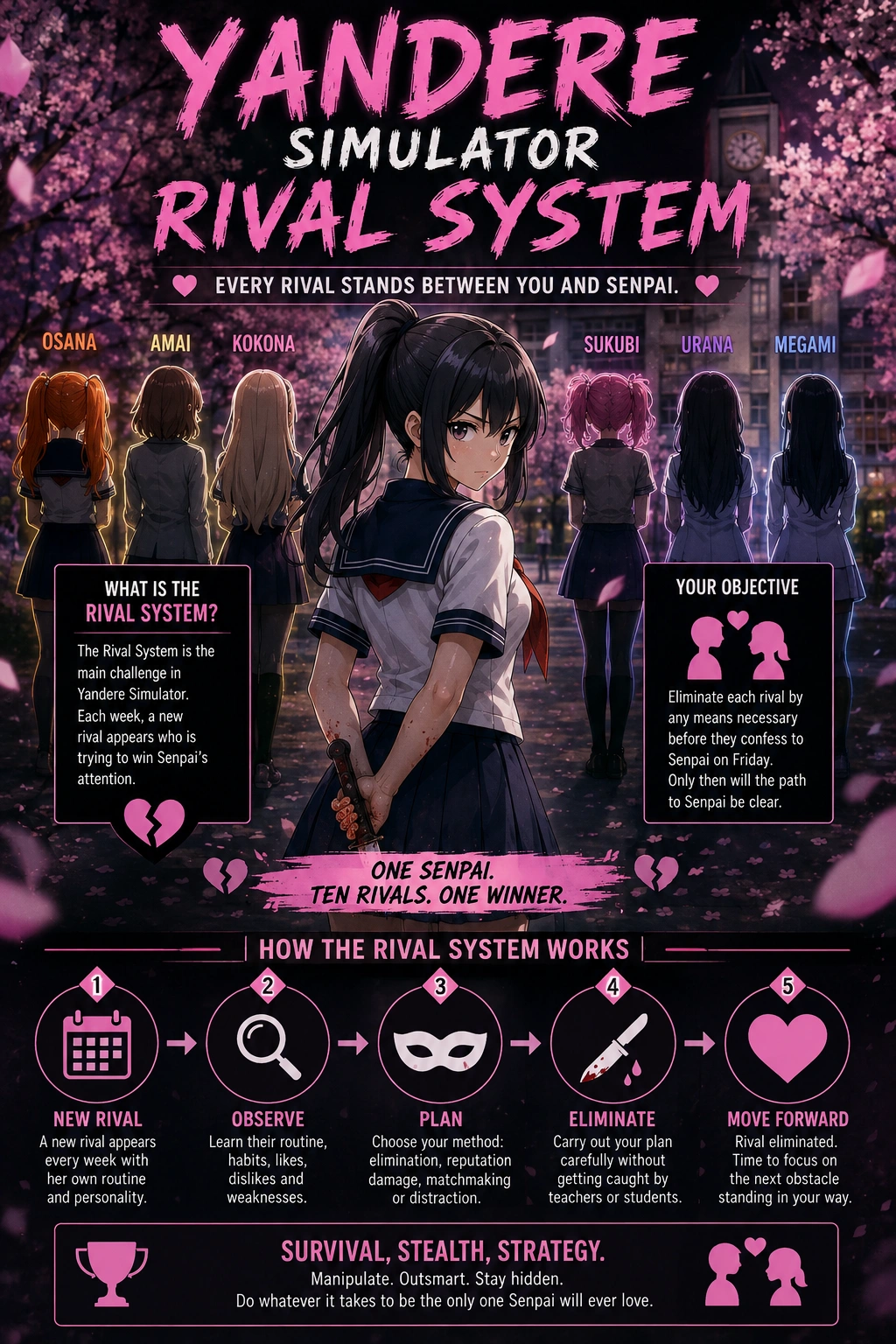
How the Rival System Works
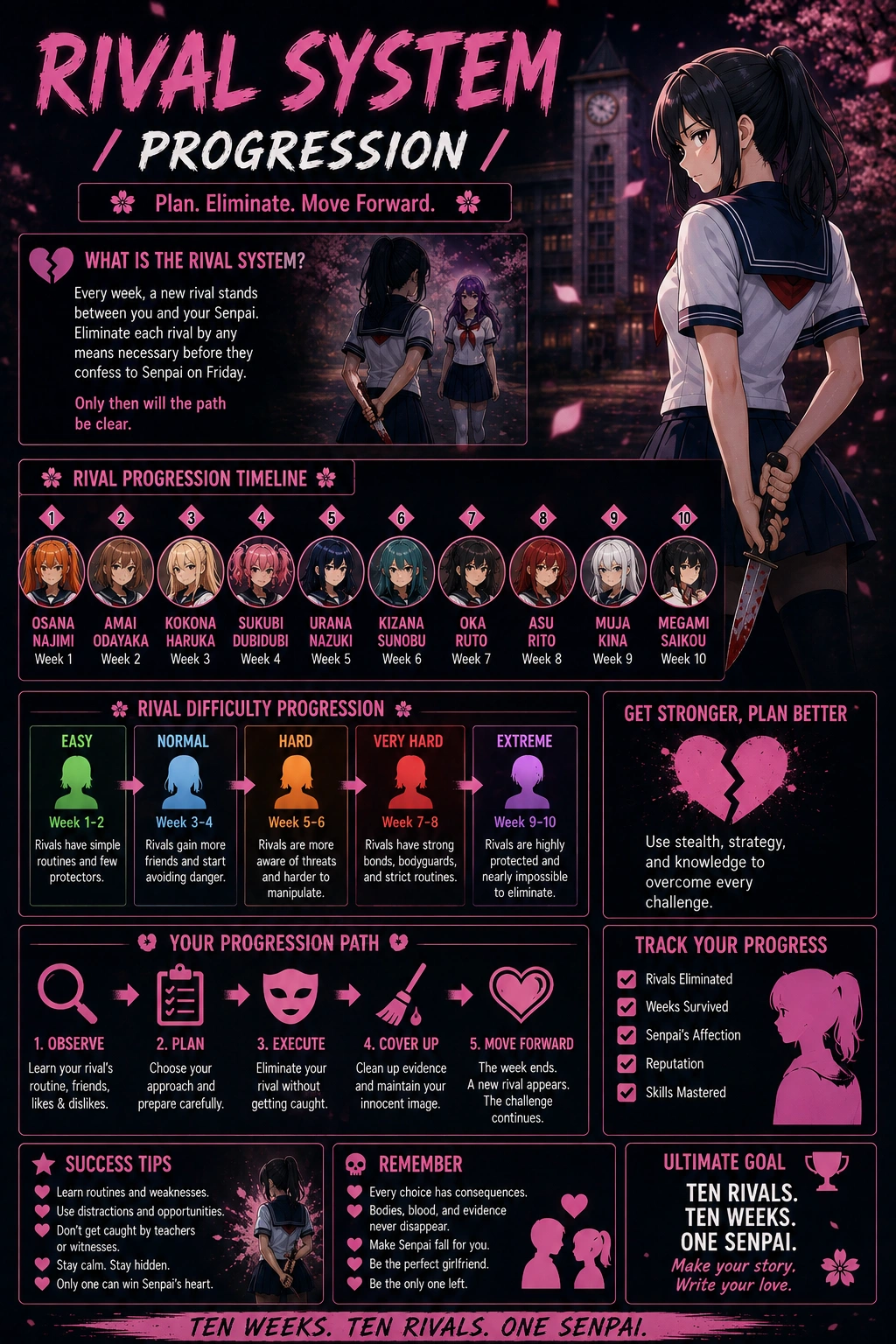
The rival system follows a weekly structure. A new character becomes the main focus, and the player has a limited amount of time to understand the situation before an important outcome can occur.
During that period, routines can be observed and relationships can be investigated. The game encourages players to learn how a rival spends her time rather than assuming every opportunity will be immediately obvious.
A successful plan often depends on timing. Being in the right location without understanding what happens there can still lead to mistakes.
Daily Routines and Schedules
Rivals move through the school and interact with different people throughout the day. Their schedules can include classes, club activities, conversations, meals, and other events. Watching these patterns helps identify moments when a character is isolated or distracted. It can also reveal which people are most closely connected to her.
Friends and Important Relationships
The people surrounding a rival can have a major influence on gameplay. A close friend may provide protection, while other students can witness suspicious behavior or unintentionally interfere with a plan. This is why focusing only on Senpai and the rival can sometimes be a mistake. The wider social environment is often just as important.
Core Rival Mechanics
Beyond the general weekly structure, the rival system runs on a few specific rules that shape how each week plays out. Every rival interacts with Senpai at least twice per day. These repeated interactions are what cause his feelings toward her to grow over the course of the week, which is why letting a rival’s routine continue unchecked for too long makes her harder to handle later.
Different Ways to Handle a Rival
The game provides more than one possible approach to dealing with a rival. Some methods focus on changing her circumstances, while others involve directly removing her as a threat. Befriending can involve learning about personal problems and helping solve them.
Matchmaking attempts to redirect romantic feelings toward someone else, while social or reputation-based approaches can change how other students view the character. More direct methods also exist, but the best choice depends on the player’s preferred style and the situation being handled.
Why Observation Matters
One of the most useful habits is to spend time learning before committing to a plan. A rival’s routine can reveal opportunities that are easy to miss when everything is approached too quickly.
I learned this during gameplay because trying to force an idea at the first available moment often created more work than simply waiting. A few minutes spent checking who was nearby could completely change the safest approach.
Yandere Simulator Male Rivals
Male rivals are not part of the standard main rival lineup in the same way as the established 202X female characters. The term is commonly connected with alternative concepts, fan creations, or modified versions that imagine how the story might work with male characters competing for Senpai’s attention.
The idea is interesting because changing the rival’s gender could also change personalities, relationships, and visual designs. However, fan concepts should be kept separate from the established main storyline unless they are officially included in the version being discussed.
Yandere Simulator Male Rivals Names
Searches for male rival names often lead to fan-made character concepts, alternate versions, or community-created gender-swapped interpretations. These names and designs can vary depending on the creator, so they should not automatically be treated as part of the official rival roster.
Yandere Simulator Genderbend Rivals
Gender-swapped rival concepts imagine existing characters with altered genders while keeping some connection to their original role or personality. Fan artists and community creators may redesign appearances, names, relationships, and character behavior in different ways.
There is no single interpretation that applies to every fan version. One creator may keep the original personality almost unchanged, while another may completely redesign the character. These concepts can be enjoyable for creative discussions, but they should be identified clearly as alternate or fan-created material rather than automatically presented as official story content.
Test Rivals and Early Development History
Before the current rival lineup was finalized, Yandere Simulator went through several test and placeholder rival characters during development. These aren’t part of the final game’s rival roster, but they’re a useful piece of context for understanding how the system evolved.
Sumire Saito – Original Prototype Test Rival
Sumire Saito was a test rival from the original Yandere Simulator Prototype. She shared Ayano’s base model but used different stockings, hair, and eye colors. She hasn’t appeared in the game since, though her name was later reused, slightly altered, for Sumire Saitozaki in 1980s Mode.
Victim-chan – Witness Reaction Test
Victim-chan was the second test rival, created specifically to demonstrate how students react to witnessing murder and how a player might get away with it. She was eventually removed once her purpose was served.
Rival-chan – Yandere Vision Test Model
Rival-chan used Osana Najimi’s original model, which is why the two are frequently confused. Her role was to test the red rival outline used by Yandere Vision and the “string of fate” mechanic, effectively standing in for Osana before she was fully implemented. She later shared her appearance with Raibaru Fumetsu until Raibaru’s design was altered and eventually revamped.
Kokona Haruka – Final Test Rival, Now Canon Student
Kokona Haruka was the fourth and final test rival and unlike the others, she wasn’t removed from the game. Instead, she became a regular student with no romantic interest in Senpai. Canonically, she did have a brief crush on him before the game’s events but realized they had little in common. She’s no longer a functioning rival, but her backstory from that period remains canon, and she now serves as the character who introduces new players to various elimination methods after the game’s tutorial.
Yandere Simulator Rivals Mod
Mods can change how the rival system works or introduce alternative characters and scenarios. Depending on the project, a modification may focus on new appearances, custom storylines, altered gameplay, or characters that are not part of the standard game.
The quality and accuracy of these projects can vary significantly. Some are created as simple visual changes, while others attempt to build entirely new experiences around the original concept. Players should therefore check which version or modification is being discussed before assuming that a character or feature exists in the official game.
What Makes Each Rival Different?
Every rival has a combination of personality, routine, relationships, and story circumstances. These details work together to create a challenge that feels connected to the individual character.
A close friend can make one rival difficult to isolate. A busy club schedule may create challenges for another. Family relationships, school positions, athletic ability, and social reputation can all change how a particular week feels.
This variety prevents the rival system from becoming entirely repetitive. The basic objective remains connected to Senpai, but the path toward that objective can change significantly.
Rivals and Senpai
Senpai is the central connection shared by the rival system. Each major rival becomes important because her relationship with him has the potential to develop into something that threatens Ayano’s goal.
The strength and nature of those connections are not identical. Some characters have a long history with him, while others become closer through new interactions and shared circumstances.
That difference gives the storyline more personality. A childhood friend creates one type of conflict, while a newly formed attraction creates another.
Why Rival Weeks Become more Challenging
The rival structure can become more demanding as new characters introduce additional complications. Players may have to consider stronger relationships, more witnesses, difficult routines, or rivals with greater influence.
The school itself also plays an important role. Students move around, teachers observe behavior, and different locations create different risks.
The biggest lesson is that a good strategy is not always about acting quickly. Sometimes the smarter option is to wait, gather information, and choose a moment when the circumstances are more manageable.
My First Hands-On Experience With the Rival System
Spending time with the rival system made it clear to me that the biggest mistake is treating every week as if it follows the same pattern. During the earlier rival weeks, I found myself paying much more attention to the character’s routine than I expected. Simply knowing where a rival normally goes was useful, but it was not enough on its own. I also had to notice who stayed nearby, when conversations happened, and which parts of the school became busy at different times.
Osana was a good example of this because her connection with Raibaru made the surrounding characters important from the beginning. It taught me that watching the rival alone does not give the complete picture. Later rivals felt different because their personalities, clubs, responsibilities, and relationships changed the way I looked at each situation.
I also found that rushing usually created more problems than it solved. When I tried to act before understanding what was happening around a rival, I had fewer options and had to adjust my plan. Taking time to observe first made the week feel much more manageable.
What I enjoyed most was how the rival system combines character behavior with the school environment. Instead of simply completing the same objective repeatedly, I had to adapt my approach based on the person I was dealing with. That made the individual rival weeks feel more distinct and gave the gameplay a stronger sense of progression.
Frequently Asked Questions
How many main rivals are there in Yandere Simulator? ▾
The main 202X storyline is built around ten major rivals, each intended to have her own week, personality, and connection to Senpai.
Who is the first rival? ▾
Osana Najimi is generally presented as the first major rival in the 202X storyline and serves as an introduction to the wider rival system.
Are all rivals in love with Senpai? ▾
The rivals become important because of their potential relationship with Senpai, although the nature and development of that connection can differ from character to character.
Who is the final major rival? ▾
Megami Saikou is positioned as one of the most significant and challenging figures in the main rival storyline.
Does 1980s Mode have different rivals? ▾
Yes. The 1980s setting follows Ryoba Aishi and includes a separate group of characters connected to Jokichi and that earlier storyline.
Are male rivals official main characters? ▾
Male rival concepts are commonly associated with alternate ideas, fan creations, or modified content rather than the standard main rival lineup.
Can a rival be handled without direct elimination? ▾
Yes. Depending on the available gameplay systems, approaches such as befriending or matchmaking can provide alternatives to direct confrontation.
Information Accuracy and Updates
Yandere Simulator is a game that has been developed over time, so gameplay systems, rival availability, routines, and story details can change depending on the version being discussed.
For that reason, information about a particular character should be considered alongside the relevant version of the game. Older videos, fan projects, mods, and community discussions may not always represent the current official experience.
It is also important to separate official character information from fan-made concepts. Gender-swapped versions, custom rivals, mods, and community-created stories can be popular, but they do not automatically become part of the established storyline.
Final Thoughts
The rival system is one of the most important parts of Yandere Simulator because it combines character stories with changing gameplay challenges. Every major rival brings a different personality, relationship, routine, and social environment into the school.
The best part is that the characters are not all approached in exactly the same way. Observation, timing, planning, and understanding relationships can matter as much as the action itself.
For anyone trying to understand the game’s story and progression, learning about the rivals is a natural starting point. Their individual situations explain much of how the rival system works while also showing why each week can feel different from the last.