Yandere Simulator 1980s Mod – Complete Guide & Characters
The Yandere Simulator 1980s Mod is a popular way to explore the earlier timeline of Yandere Simulator, especially for players who want to experience the story surrounding Ryoba Aishi. Instead of following Ayano’s modern-day school life, this setting takes the story back to the 1980s and introduces a different cast, atmosphere, and progression.
The 1980s storyline has its own identity while keeping many of the ideas that make Yandere Simulator recognizable. Ryoba becomes the playable character, Jokichi takes the role of Senpai, and a new group of girls becomes involved in the weekly storyline.
For anyone searching for Yandere Simulator 1980s, 1980s Yandere Simulator, or a 1980s Mode Yandere Simulator guide, understanding the story and gameplay system is a good starting point. The characters are not simply older versions of the modern cast. They belong to a different generation and help explain an earlier part of the game’s world.
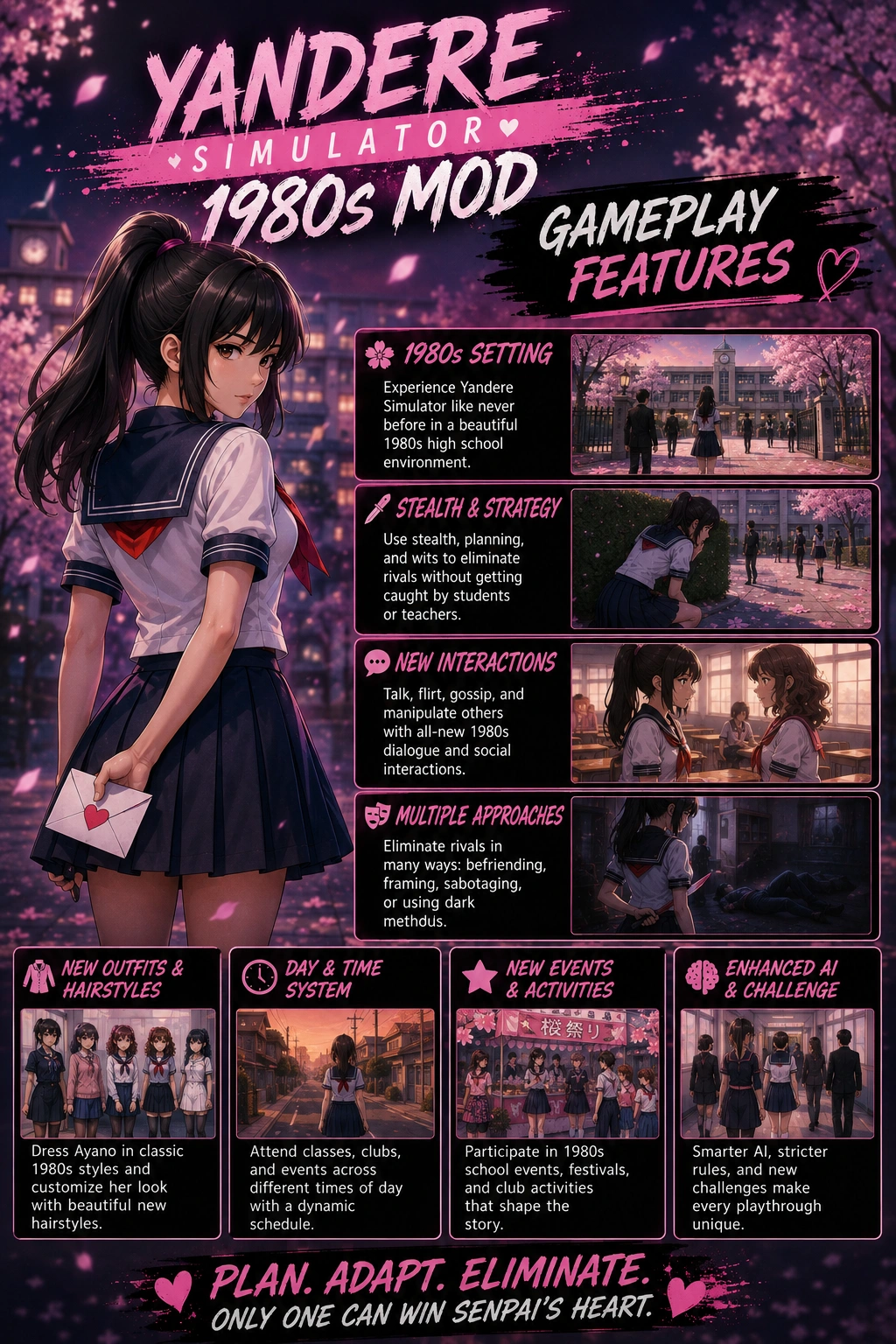
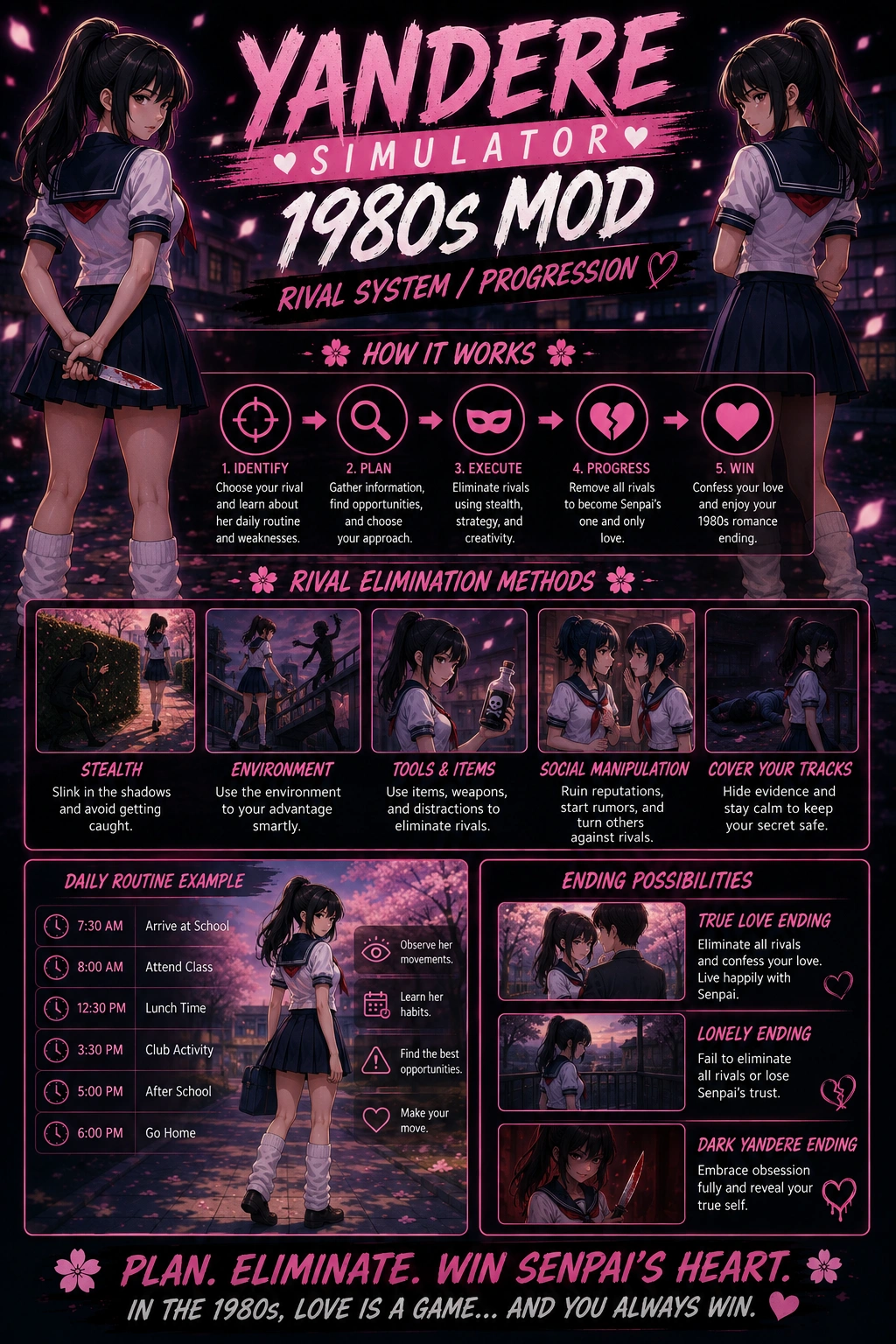
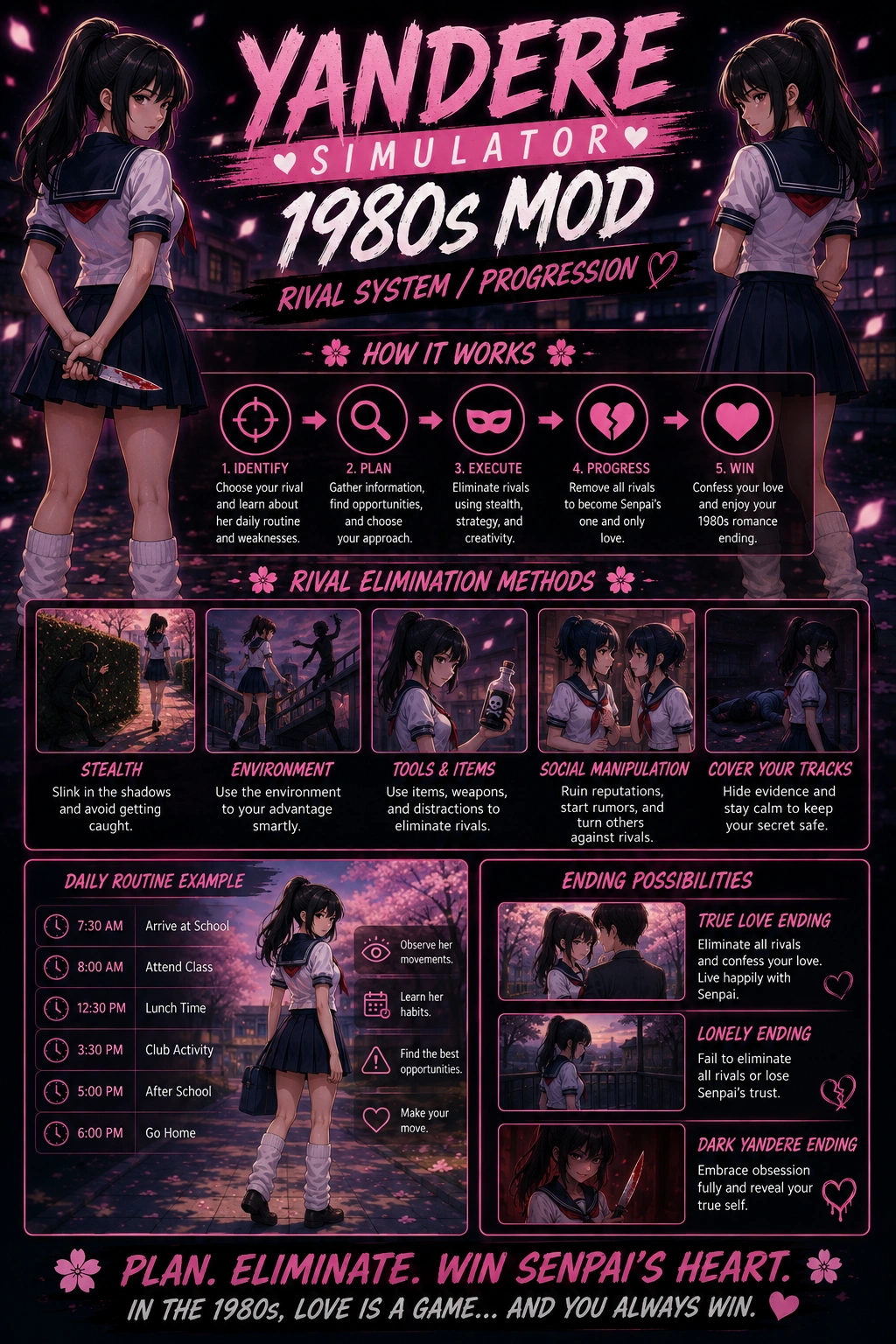
What is the Yandere Simulator 1980s Mod?
The term Yandere Simulator 1980s Mod is commonly used when searching for content related to the game’s 1980s setting. It is important, however, to distinguish between the game’s built-in 1980s Mode and an actual fan-made modification.
The official 1980s storyline follows Ryoba Aishi and is set decades before Ayano’s main storyline. It introduces its own characters and ten-week progression, giving players another perspective on the game’s universe. The official character page lists Ryoba, Jokichi, and the 1980s cast separately from the modern characters.
Fan-made modifications can go further by changing models, environments, characters, mechanics, or story elements. Because those projects are created by different people, their content can vary considerably.
So, when looking for a specific Yandere Simulator 1980s Mod, it is worth checking whether the page is referring to the official 1980s Mode or a community-made project.
Yandere Simulator 1980s Story
The 1980s storyline focuses on Ryoba Aishi and her growing obsession with Jokichi Yudasei.
The basic premise is familiar to players of the modern game. Ryoba becomes interested in Jokichi, while other girls begin developing feelings for him. This creates the central conflict that drives the weekly progression.
What makes the story interesting is its historical position. The events take place before Ayano’s generation, so the mode gives players a chance to see an earlier chapter of the Aishi family’s story.
The setting also changes the atmosphere. The school, characters, fashion, technology, and general presentation are designed around an earlier period rather than the contemporary world shown in the main storyline.
Ryoba Aishi and Jokichi Yudasei
Ryoba Aishi is the protagonist of the 1980s storyline, while Jokichi Yudasei is the person she becomes obsessed with. Their relationship provides the foundation for the entire mode. As the weeks progress, different girls become interested in Jokichi, forcing Ryoba to deal with each new situation.
This makes Jokichi more than just a background character. His interactions with the girls are what drive the weekly structure and give Ryoba a reason to pay attention to what is happening around the school.
The official character listing includes both Ryoba Aishi and Jokichi Yudasei among the game’s characters, alongside the individual 1980s characters.
Yandere Simulator 1980s Mode Characters
The Yandere Simulator 1980s Mode characters form a separate generation from the modern cast. Ryoba and Jokichi are the central figures, while the wider cast includes students, teachers, rivals, Student Council members, and other characters who make the school environment feel alive.
The ten major characters connected to the weekly storyline are:
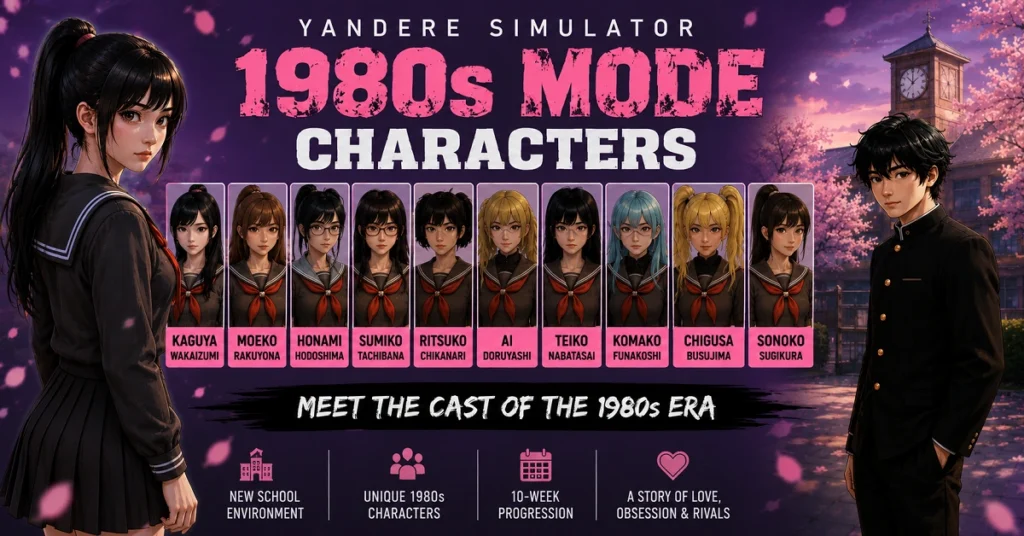
These characters are part of the official Yandere Simulator character roster and represent the different weekly stages of the 1980s storyline.
Sumire Saitozaki – The Tutorial Rival
Before the ten major weekly rivals begin, Sumire Saitozaki appears as a tutorial character in 1980s Mode. She develops feelings for Jokichi and is eliminated by Ryoba as an introductory sequence, meant to familiarise players with the game’s basic mechanics before the full weekly structure starts with Kaguya Wakaizumi.
Unlike the ten main rivals, Sumire is not part of the weekly progression and does not appear during the standard story mode playthrough. However, she remains part of the wider 1980s cast, and her presence can still be noticed afterward — her ghost appears in the third-floor girls’ bathroom, similar to how eliminated rivals are represented elsewhere in the game.
For players researching the complete 1980s Mode cast, Sumire is worth knowing about separately from the ten major rivals since she serves a different narrative purpose, introducing the mode rather than driving one of its ten weekly storylines.
Yandere Simulator 1980s Mode Rivals
The rival system remains an important part of the 1980s storyline, but it is only one component of the larger mode. Each week introduces a different girl who has developed feelings for Jokichi. Ryoba has until the end of the week to prevent that relationship from becoming a serious problem.
The weekly format gives the game a clear progression. Early weeks allow players to become familiar with the environment, while later weeks can feel more demanding because the player already understands the basic mechanics and must adapt them to different characters.
The ten 1980s rivals are Kaguya, Moeko, Honami, Sumiko, Ritsuko, Ai, Teiko, Komako, Chigusa, and Sonoko. Their names appear in the official character roster.
Yandere Simulator 1980s Gameplay
Gameplay in the 1980s setting revolves around managing Ryoba’s school life while dealing with the situations created by each week’s target. Observation is an important part of the experience. Characters follow routines, visit different locations, interact with other students, and participate in school activities.
Rather than rushing into every situation, it often makes more sense to understand what is happening first. Knowing where a character normally spends time can make planning much easier.
The school environment also matters. Other students can be nearby; different areas have different levels of activity, and unusual behavior can attract attention.
How 1980s Mode Progression Works
The storyline is divided into weeks, with each week focusing on a different rival. At the beginning of a new week, the player has time to understand the character and her routine. As the week progresses, her relationship with Jokichi develops.
This creates a natural rhythm. First comes observation, followed by planning and then action. One useful thing about this structure is that players are not forced to learn everything at once. Each new week provides another opportunity to understand how the school environment works.
What Players Should Understand Before Starting a New Week
One important part of 1980s Mode is that preparation can be just as valuable as taking action. A new week introduces a different character, but the surrounding school environment remains active. Friends, nearby students, school locations, and daily routines can all affect how easily a player can carry out a plan.
A practical approach is to spend the early part of a week gathering information instead of assuming that every objective should be handled immediately. Learning a character’s usual movements can reveal quieter opportunities and also help players avoid unnecessary attention.
Players should also remember that methods which work well in one situation may not always be equally convenient in another. Different characters have different routines and social situations, so adapting to the current week is usually more effective than repeating the exact same strategy every time.
This is one of the reasons the progression system remains engaging. The basic gameplay systems become more familiar over time, while the changing characters encourage players to apply that knowledge in different situations.
Yandere Simulator 1980s Mode Student Council
The Yandere Simulator 1980s Mode Student Council is part of the wider school environment. Student Council members add another layer to the school because they represent authority and observation. Their presence means that the player needs to pay attention to more than just the current rival.
The Student Council is also listed as a distinct group within the official Yandere Simulator character information. For players exploring the 1980s setting, understanding the different groups around the school can make the environment easier to navigate.
Features of Yandere Simulator’s 1980s Mode
Yandere Simulator’s 1980s Mode offers a completely different experience, taking players out of the modern 202X setting and back to 1989 Japan. This mode functions as a prequel to the game’s main story and offers deep insight into the Aishi family’s past.
1980s Setting
The entire mode is set in 1989, where only the technology of that era is available, meaning no internet, smartphones, or Info-chan. The smartphone is replaced with a notepad, and if a student witnesses a murder, they call the police using the landline phone in the faculty room. School rules are also stricter in this era. There’s also an optional VHS-style grainy filter that gives the game an old movie look, and the background music has been remixed in a synthwave style to perfectly match the 80s vibe.
Ryoba as the Protagonist
In this mode, instead of Ayano Aishi, the player controls her mother, Ryoba Aishi. Ryoba is the 10th generation of the Aishi family, and her character is portrayed as far colder, more brutal, and more murderous than Ayano. She doesn’t hesitate to eliminate any rival who threatens to come between her and her senpai, Jokichi Yudasei.
Ten-Week Storyline
Like the main mode, this mode’s progression is also divided into ten rival weeks, with a different character becoming the focus each week. But one special feature of this mode is the Yakuza character, who exists only in 1980s Mode. This character provides Ryoba with favors and helps her eliminate rivals, something that doesn’t exist in 202X Mode.
Different Character Generation
The cast in this mode belongs to an earlier generation, which is quite useful for understanding the game’s wider lore and history. For players who want to understand the Aishi family’s background and the roots of their “yandere” nature, this mode turns out to be quite fascinating.
Historical Story Context
1980s Mode isn’t just a different setting; it also provides necessary context about the characters and events of the main storyline. Ryoba meets her senpai Jokichi at the same school and in a somewhat similar way to how Ayano meets hers. The player’s choices and the endings can also affect the main 202X mode’s storyline in the future, which means this mode isn’t just backstory; it’s an important part of the canon itself.
Yandere Simulator 1980s vs 202X Mode
The two timelines share the same basic concept but have important differences.
| Feature | 1980s Mode | 202X Mode |
|---|---|---|
| Protagonist | Ryoba Aishi | Ayano Aishi |
| Senpai | Jokichi Yudasei | Taro Yamada |
| Setting | 1980s | Modern era |
| Main storyline | Ryoba’s generation | Ayano’s generation |
| Rivals | 1980s characters | Modern rivals |
| Timeline | Earlier generation | Main modern storyline |
| Main purpose | Historical story | Primary ongoing storyline |
The comparison shows why the 1980s setting should be treated as its own storyline rather than simply a reskin of the modern game.
Yandere Simulator 1980s Characters and Their Roles
The characters in the earlier timeline are important because they help establish the world around Ryoba. Some characters are directly connected to the weekly story, while others contribute to the school’s everyday environment. Student Council members, teachers, students, and other groups help create a setting where Ryoba’s actions take place.
The official roster includes a wide range of 1980s characters in addition to the ten major weekly characters. This broader cast is one reason the mode feels like a complete historical setting instead of a small side story.
Why the 1980s Setting Matters
The biggest strength of the 1980s storyline is the additional context it provides.
Players who already know Ayano’s story can look at the earlier timeline and see where certain elements of the wider narrative fit. Ryoba’s story gives the Aishi family a stronger historical background and provides another perspective on the game’s central themes.
The setting also changes the experience in smaller ways. The visual style and atmosphere feel different, while the characters belong to another generation. That combination gives the mode its own personality.
Tips for Playing Yandere Simulator 1980s Mode
A good starting strategy is to learn the environment before making major decisions. Watch the character you are dealing with and notice where she goes during different parts of the day. Pay attention to friends and other students who regularly appear nearby.
It is also useful to avoid unnecessary attention. A plan can fail simply because the wrong person notices something at the wrong time. I found that taking a little extra time to understand a routine was usually more useful than trying to rush through the week. Once the surroundings became familiar, planning felt much more natural.
My Experience With the 1980s Mode
After spending time with Yandere Simulator’s 1980s Mode, the part I appreciated most was how the familiar gameplay loop felt different when viewed through Ryoba’s story. At first, I expected the mode to feel like a simple version of the main storyline with older characters, but the different setting and weekly cast gave it its own identity.
I found that observing a character before making any major decision was much more useful than immediately trying to complete an objective. Watching routines, noticing where other students gathered, and paying attention to who was nearby helped me understand how each situation could develop. In some cases, taking extra time at the beginning made the rest of the week feel easier because I already knew the environment and the important characters around me.
The weekly structure also kept the experience from feeling repetitive. Although the main idea remains consistent, each character brings a different personality and routine into the school environment. That encouraged me to pay attention instead of relying on exactly the same approach every time.
Another thing I noticed was the atmosphere. Playing as Ryoba and interacting with an entirely different generation made the school feel familiar but not identical to the modern timeline. For me, that historical perspective was one of the strongest reasons to explore the mode, especially after already becoming familiar with Ayano’s storyline.
Is Yandere Simulator 1980s Mode Worth Playing?
For players interested in the story, characters, or history of Yandere Simulator, 1980s Mode is worth exploring. It provides a different protagonist, a separate cast, and a storyline that takes place before the modern events.

Someone who only knows Ayano’s story may find the historical perspective especially interesting. It is also a good option for players who enjoy learning character routines and experimenting with different approaches to weekly objectives.
Is Yandere Simulator 1980s Mod Different From the Original Game?
A fan-made Yandere Simulator 1980s Mod can be different from the built-in 1980s Mode
A modification may change character appearances, add new characters, alter gameplay systems, replace environments, or introduce custom story content. Because fan-made mods are developed independently, their features should not automatically be considered part of the official game.
The official game website itself distinguishes fan-made mods from the standard game when discussing bug reports and development issues.
Yandere Simulator 1980s Mod Updates and Compatibility
Anyone using a fan-made modification should pay attention to the version of the base game and the mod itself.
Game updates can change files or mechanics, which may cause an older modification to stop working correctly. The official developer notes that new builds can be updated frequently and specifically recommends using the latest version when reporting bugs.
This is also why old videos and guides can sometimes be misleading. A method shown in an older build may not behave exactly the same way today.
Information and Mod Availability
This article discusses both Yandere Simulator’s official 1980s Mode and the broader use of the term “1980s Mod” for community-made projects. These are not always the same thing.
Features, characters, gameplay changes, and compatibility information for a fan-made modification can depend on its specific creator and version. Before downloading or using any unofficial modification, players should check its original source and confirm which version of the base game it supports.
Game information can also change as new builds are released. For that reason, older videos, screenshots, and guides may describe features that work differently in newer versions. When accuracy is important, official game information should be checked alongside the details provided by the creator of a specific community modification.
Frequently Asked Questions
What is Yandere Simulator 1980s Mode? ▾
It is a historical storyline set in the 1980s that follows Ryoba Aishi and her relationship with Jokichi Yudasei.
Who is the protagonist of Yandere Simulator 1980s? ▾
Ryoba Aishi is the protagonist of the 1980s storyline.
Who is the Senpai in 1980s Mode? ▾
Jokichi Yudasei is the central love interest and Senpai connected to Ryoba’s storyline.
How many rivals are in 1980s Mode? ▾
The storyline has ten major weekly rivals, beginning with Kaguya Wakaizumi and ending with Sonoko Sakanoue. The official character page lists these 1980s characters.
Is Yandere Simulator 1980 the same as 1980s Mode? ▾
The terms are commonly used to refer to the same historical setting, although “1980s Mode” is the more specific name for the game’s mode.
Does 1980s Mode have a Student Council? ▾
Yes. Student Council is part of the wider character groups found in the game.
Is Yandere Simulator 1980s Mod an official mod? ▾
The phrase can refer to fan-made modifications, while the official game contains its own 1980s Mode. These should be kept separate when discussing features and characters.
Can a 1980s Mod change the characters? ▾
Yes. A fan-made modification can potentially change characters, visuals, mechanics, or other content, depending on what its creator has changed.
Updated and Reliable Information
Yandere Simulator continues to receive development updates, so information from older guides may not always match the current build.
The official developer specifically warns that videos can become outdated quickly because new builds are updated frequently. Fan-made modifications can introduce another layer of version differences.
For that reason, it is useful to check whether information comes from the official game, an older build, or a community-made modification before relying on it.
Final Verdicts
The Yandere Simulator 1980s Mod topic is closely connected to one of the game’s most interesting historical storylines. The 1980s setting introduces Ryoba Aishi, Jokichi Yudasei, a different generation of characters, and a separate ten-week progression.
What makes the mode stand out is not simply the change in year. The different protagonist, characters, atmosphere, and story context give players another way to understand the Yandere Simulator universe.
For anyone searching for Yandere Simulator 1980s, Yandere Simulator 1980s Mode characters, or a Yandere Simulator 1980s Mode guide, starting with the story, main cast, weekly progression, and differences from the modern timeline provides a much clearer picture of what this setting offers.